
JP Home Inspections LLC
6211 80th St NE
Marysville WA 98270-3364
Marysville WA 98270-3364
Inspector: John Parkowski
Washington State Home Inspector License #24012269
Summary
Unofficial version!
| Client(s): | Dulce Puga |
| Property address: | 347 SE Glencoe St Oak Harbor WA 98277 |
| Inspection date: | Thursday, May 14, 2026 |
This report published on Friday, May 15, 2026 7:57:30 AM PDT
This report is the exclusive property of this inspection company and the client(s) listed in the report title. Use of this report by any unauthorized persons is prohibited.
 | Safety | Poses a safety hazard |
 | Major Defect | Correction likely involves a significant expense |
 | Repair/Replace | Recommend repairing or replacing |
 | Repair/Maintain | Recommend repair and/or maintenance |
 | Maintain | Recommend ongoing maintenance |
 | Evaluate | Recommend evaluation by a specialist |
 | Comment | For your information |
1) 
 Structures built prior to the mid 1980s may contain lead and/or asbestos. Lead is commonly found in paint and in some plumbing components. The EPA does not recognize newer coats of paint as encapsulating older coats of lead-based paint. Asbestos is commonly found in various building materials such as insulation, siding, and/or floor and ceiling tiles. Laws were passed in 1978 to prohibit usage of lead and asbestos, but stocks of materials containing these substances remained in use for a number of years thereafter. Both lead and asbestos are known health hazards. Evaluating for the presence of lead and/or asbestos is beyond the scope of this inspection. Any mention of these materials in this report is made as a courtesy only, and meant to refer the client to a specialist. Consult with specialists as necessary, such as industrial hygienists, professional labs and/or abatement specialists for this type of evaluation. For information on lead, asbestos and other hazardous materials in homes, visit:
https://www.reporthost.com/?EPA
https://www.reporthost.com/?CPSC
https://www.reporthost.com/?CDC
Structures built prior to the mid 1980s may contain lead and/or asbestos. Lead is commonly found in paint and in some plumbing components. The EPA does not recognize newer coats of paint as encapsulating older coats of lead-based paint. Asbestos is commonly found in various building materials such as insulation, siding, and/or floor and ceiling tiles. Laws were passed in 1978 to prohibit usage of lead and asbestos, but stocks of materials containing these substances remained in use for a number of years thereafter. Both lead and asbestos are known health hazards. Evaluating for the presence of lead and/or asbestos is beyond the scope of this inspection. Any mention of these materials in this report is made as a courtesy only, and meant to refer the client to a specialist. Consult with specialists as necessary, such as industrial hygienists, professional labs and/or abatement specialists for this type of evaluation. For information on lead, asbestos and other hazardous materials in homes, visit:https://www.reporthost.com/?EPA
https://www.reporthost.com/?CPSC
https://www.reporthost.com/?CDC
2)  Evidence of rodent infestation was found in the form of feces in the attic. Consult with the property owner about this. A qualified person should make repairs to seal openings in the structure, set traps, and clean rodent waste as necessary. Recommend following guidelines in these Center for Disease Control articles:
https://www.reporthost.com/?SEALUP
https://www.reporthost.com/?TRAPUP
https://www.reporthost.com/?CLEANUP
Evidence of rodent infestation was found in the form of feces in the attic. Consult with the property owner about this. A qualified person should make repairs to seal openings in the structure, set traps, and clean rodent waste as necessary. Recommend following guidelines in these Center for Disease Control articles:https://www.reporthost.com/?SEALUP
https://www.reporthost.com/?TRAPUP
https://www.reporthost.com/?CLEANUP
4) Handrails at one or more flights of stairs were missing. This is a potential fall hazard. Handrails should be installed at stairs with four or more risers or where stairs are greater than 30 inches high. Recommend that a qualified contractor install handrails where missing and per standard building practices.
Handrails at one or more flights of stairs were missing. This is a potential fall hazard. Handrails should be installed at stairs with four or more risers or where stairs are greater than 30 inches high. Recommend that a qualified contractor install handrails where missing and per standard building practices.
5) Guardrails at one or more locations with drop-offs higher than 30 inches had gaps that were too large. This poses a safety hazard for children (e.g. falling, getting stuck in railing). Guardrails should not have gaps or voids that allow passage of a sphere equal to or greater than 4 inches in diameter, or 6 inches in diameter at triangular spaces between stair edges and guardrails. At a minimum, the client should be aware of this hazard. Recommend that a qualified contractor repair or replace guardrails per standard building practices.
Guardrails at one or more locations with drop-offs higher than 30 inches had gaps that were too large. This poses a safety hazard for children (e.g. falling, getting stuck in railing). Guardrails should not have gaps or voids that allow passage of a sphere equal to or greater than 4 inches in diameter, or 6 inches in diameter at triangular spaces between stair edges and guardrails. At a minimum, the client should be aware of this hazard. Recommend that a qualified contractor repair or replace guardrails per standard building practices.
6)  Cracks, holes, settlement, heaving and/or deterioration resulting in trip hazards were found in the driveway, For safety reasons, recommend that a qualified contractor repair as necessary.
Cracks, holes, settlement, heaving and/or deterioration resulting in trip hazards were found in the driveway, For safety reasons, recommend that a qualified contractor repair as necessary.
7) Guardrails at one or more locations with drop-offs higher than 30 inches were loose and/or wobbly, and pose a fall hazard. Recommend that a qualified person repair guardrails as necessary.
Guardrails at one or more locations with drop-offs higher than 30 inches were loose and/or wobbly, and pose a fall hazard. Recommend that a qualified person repair guardrails as necessary.
10) Some sections of siding and/or trim were split and/or rotten. Recommend that a qualified person repair, replace or install siding or trim as necessary.
Some sections of siding and/or trim were split and/or rotten. Recommend that a qualified person repair, replace or install siding or trim as necessary.
11) One or more minor cracks (1/8 inch or less) were found in the garage foundation. These didn't appear to be a structural concern, but recommend sealing them to prevent water infiltration and monitor them in the future. Numerous products exist to seal such cracks including hydraulic cement, non-shrinking grout, resilient caulks and epoxy sealants.
One or more minor cracks (1/8 inch or less) were found in the garage foundation. These didn't appear to be a structural concern, but recommend sealing them to prevent water infiltration and monitor them in the future. Numerous products exist to seal such cracks including hydraulic cement, non-shrinking grout, resilient caulks and epoxy sealants.
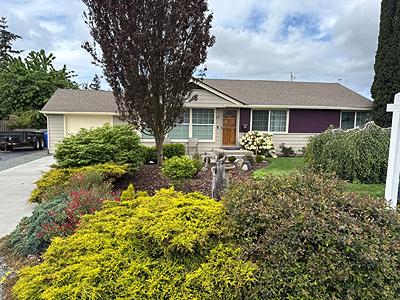
12)  Vegetation such as trees, shrubs and/or vines was in contact with or close to the building exterior. Vegetation can serve as a pathway for wood-destroying insects and can retain moisture against the exterior after it rains. This is a conducive condition for wood-destroying organisms. Recommend pruning, moving or removing vegetation as necessary to maintain at least 6 inches of space between it and the building exterior. A 1-foot clearance is better.
Vegetation such as trees, shrubs and/or vines was in contact with or close to the building exterior. Vegetation can serve as a pathway for wood-destroying insects and can retain moisture against the exterior after it rains. This is a conducive condition for wood-destroying organisms. Recommend pruning, moving or removing vegetation as necessary to maintain at least 6 inches of space between it and the building exterior. A 1-foot clearance is better.
13) Trees were in contact with or were close to the building at one or more locations. Damage to the building can occur, especially during high winds, or may have already occurred (see other comments in this report). Recommend that a qualified tree service contractor or certified arborist remove trees as necessary to prevent damage to the building exterior.
Trees were in contact with or were close to the building at one or more locations. Damage to the building can occur, especially during high winds, or may have already occurred (see other comments in this report). Recommend that a qualified tree service contractor or certified arborist remove trees as necessary to prevent damage to the building exterior.
14) The paint or stain finish in some areas was failing (e.g. peeling, faded, worn, thinning). Siding and trim with a failing finish can be damaged by moisture. Recommend that a qualified contractor prep (e.g. clean, scrape, sand, prime, caulk) and repaint or restain the building exterior where necessary and per standard building practices. Any repairs needed to the siding or trim should be made prior to this.
The paint or stain finish in some areas was failing (e.g. peeling, faded, worn, thinning). Siding and trim with a failing finish can be damaged by moisture. Recommend that a qualified contractor prep (e.g. clean, scrape, sand, prime, caulk) and repaint or restain the building exterior where necessary and per standard building practices. Any repairs needed to the siding or trim should be made prior to this.
15) Caulk was deteriorated in some areas. For example, around windows. Recommend that a qualified person renew or install caulk as necessary. Where gaps are wider than 1/4 inch, an appropriate material other than caulk should be used. For more information, visit:
https://www.reporthost.com/?CAULK
Caulk was deteriorated in some areas. For example, around windows. Recommend that a qualified person renew or install caulk as necessary. Where gaps are wider than 1/4 inch, an appropriate material other than caulk should be used. For more information, visit:https://www.reporthost.com/?CAULK
16) Guardrails at one or more locations with drop-offs higher than 30 inches were missing. This poses a fall hazard. Guardrails should be installed where walking surfaces are more than 30 inches above the surrounding grade or surfaces below. Recommend that a qualified contractor install guardrails where missing and per standard building practices.
Guardrails at one or more locations with drop-offs higher than 30 inches were missing. This poses a fall hazard. Guardrails should be installed where walking surfaces are more than 30 inches above the surrounding grade or surfaces below. Recommend that a qualified contractor install guardrails where missing and per standard building practices.
17) One or more handrails had no returns installed, where ends of handrails turn and connect to adjacent walls so objects or clothing will not catch on the open ends. This is a safety hazard. Recommend that a qualified person install returns per standard building practices.
One or more handrails had no returns installed, where ends of handrails turn and connect to adjacent walls so objects or clothing will not catch on the open ends. This is a safety hazard. Recommend that a qualified person install returns per standard building practices.
18) Some composition shingles were damaged. Leaks can occur as a result. This is a conducive condition for wood-destroying organisms. Recommend that a qualified contractor repair as necessary. For example, by replacing shingles.
Some composition shingles were damaged. Leaks can occur as a result. This is a conducive condition for wood-destroying organisms. Recommend that a qualified contractor repair as necessary. For example, by replacing shingles.
19) One or more rubber or neoprene pipe flashings were split or cracked. Leaks can occur as a result. This is a conducive condition for wood-destroying organisms. Recommend that a qualified contractor replace flashings where necessary.
One or more rubber or neoprene pipe flashings were split or cracked. Leaks can occur as a result. This is a conducive condition for wood-destroying organisms. Recommend that a qualified contractor replace flashings where necessary.
20) One or more roof flashings were lifting, corroded and/or loose. Leaks can occur as a result. This is a conducive condition for wood-destroying organisms. Recommend that a qualified person repair as necessary.
One or more roof flashings were lifting, corroded and/or loose. Leaks can occur as a result. This is a conducive condition for wood-destroying organisms. Recommend that a qualified person repair as necessary.
21) Significant amounts of debris have accumulated in one or more gutters or downspouts. Gutters can overflow and cause water to come in contact with the building exterior, or water can accumulate around the foundation. This is a conducive condition for wood-destroying organisms. Recommend cleaning gutters and downspouts now and as necessary in the future.
Significant amounts of debris have accumulated in one or more gutters or downspouts. Gutters can overflow and cause water to come in contact with the building exterior, or water can accumulate around the foundation. This is a conducive condition for wood-destroying organisms. Recommend cleaning gutters and downspouts now and as necessary in the future.
22) Moss was growing on the roof. As a result, shingles can lift or be damaged. Leaks can result and/or the roof surface can fail prematurely. Efforts should be made to kill the moss during its growing season (wet months). Typically, zinc or phosphate-based chemicals are used for this and must be applied periodically. For information on various moss treatment products and their pros and cons, visit:
https://www.reporthost.com/?MOSS
Moss was growing on the roof. As a result, shingles can lift or be damaged. Leaks can result and/or the roof surface can fail prematurely. Efforts should be made to kill the moss during its growing season (wet months). Typically, zinc or phosphate-based chemicals are used for this and must be applied periodically. For information on various moss treatment products and their pros and cons, visit:https://www.reporthost.com/?MOSS
23) Nail heads were exposed at one or more shingles. More than just a few exposed nail heads may indicate a substandard roof installation. Recommend applying an approved sealant over exposed nail heads now and as necessary in the future to prevent leaks.
Nail heads were exposed at one or more shingles. More than just a few exposed nail heads may indicate a substandard roof installation. Recommend applying an approved sealant over exposed nail heads now and as necessary in the future to prevent leaks.
25) The ceiling insulation installed in the attic was substandard and appeared to have an R rating that's significantly less than current standards (R-38). Heating and cooling costs will likely be higher due to poor energy efficiency. Recommend that a qualified contractor install insulation for better energy efficiency and per standard building practices.
The ceiling insulation installed in the attic was substandard and appeared to have an R rating that's significantly less than current standards (R-38). Heating and cooling costs will likely be higher due to poor energy efficiency. Recommend that a qualified contractor install insulation for better energy efficiency and per standard building practices.
26) Cardboard baffles that are intended to keep insulation from blocking soffit vents in the attic were loose and had fallen down. Attic and/or roof structure ventilation can be reduced as a result. The service life for the roof surface materials can also be reduced because of high temperatures. Moisture from condensation is also likely to accumulate in the roof structure and/or attic and can be a conducive condition for wood-destroying organisms. Recommend that a qualified person repair or reattach baffles as necessary.
Cardboard baffles that are intended to keep insulation from blocking soffit vents in the attic were loose and had fallen down. Attic and/or roof structure ventilation can be reduced as a result. The service life for the roof surface materials can also be reduced because of high temperatures. Moisture from condensation is also likely to accumulate in the roof structure and/or attic and can be a conducive condition for wood-destroying organisms. Recommend that a qualified person repair or reattach baffles as necessary.
27) The photoelectric sensors that trigger the auto-reverse feature on one or more garage vehicle doors' automatic openers were located lower than 4-6 inches from the floor. This is a potential safety hazard. A qualified person should relocate sensors so they are 4-6 inches from the floor per standard building practices. For more information on garage door safety issues, visit:
https://www.reporthost.com/?GDPES
The photoelectric sensors that trigger the auto-reverse feature on one or more garage vehicle doors' automatic openers were located lower than 4-6 inches from the floor. This is a potential safety hazard. A qualified person should relocate sensors so they are 4-6 inches from the floor per standard building practices. For more information on garage door safety issues, visit:https://www.reporthost.com/?GDPES
28) The wall-mounted control for one or more automatic garage vehicle door openers was less than 5 feet off the floor, or within reach of children. This is a safety hazard. Children should not be able to operate automatic garage vehicle door openers. A qualified person should relocate controls for door openers so they are at least 5 feet above floors and/or out of reach of children. For more information on garage door safety issues, visit:
https://www.reporthost.com/?NRGD
The wall-mounted control for one or more automatic garage vehicle door openers was less than 5 feet off the floor, or within reach of children. This is a safety hazard. Children should not be able to operate automatic garage vehicle door openers. A qualified person should relocate controls for door openers so they are at least 5 feet above floors and/or out of reach of children. For more information on garage door safety issues, visit:https://www.reporthost.com/?NRGD
29)  Panel(s) #A were manufactured by the Challenger company. These panels and their circuit breakers have a history of problems including overheating of the bus bars and resulting damage to insulating structures. This is a potential safety hazard for shock and/or fire. Recommend that a qualified electrician carefully evaluate all Challenger brand panels and components and make repairs as necessary. Consider replacing Challenger panels with modern panels that offer more flexibility for new, safer protective technologies like arc fault circuit interrupters (AFCls). For more information, visit:
https://www.reporthost.com/?CHLGR1
Panel(s) #A were manufactured by the Challenger company. These panels and their circuit breakers have a history of problems including overheating of the bus bars and resulting damage to insulating structures. This is a potential safety hazard for shock and/or fire. Recommend that a qualified electrician carefully evaluate all Challenger brand panels and components and make repairs as necessary. Consider replacing Challenger panels with modern panels that offer more flexibility for new, safer protective technologies like arc fault circuit interrupters (AFCls). For more information, visit:https://www.reporthost.com/?CHLGR1
30) One or more modern, 3-slot electric receptacles were found with an open ground. Three-slot receptacles should have a hot, a neutral and a ground wire connected. Homeowners often install new 3-slot receptacles on older, 2-wire circuits that only have hot and neutral wires. This is a shock hazard when appliances that require a ground are used with these receptacles. Examples of such appliances include computers and related hardware, refrigerators, freezers, portable air conditioners, clothes washers, aquarium pumps, and electrically operated gardening tools. Where the electric system was installed prior to when grounded circuits were required (1960s), it is permissible to replace 3-slot receptacles with 2-slot receptacles to prevent appliances that require a ground from being plugged in to an ungrounded circuit. However, the client should be aware of this limitation when planning use for various rooms, such as an office. For newer electric systems, circuits should be repaired so grounded, 3-wire cables provide power to 3-slot receptacles. Recommend that a qualified electrician repair per standard building practices.
One or more modern, 3-slot electric receptacles were found with an open ground. Three-slot receptacles should have a hot, a neutral and a ground wire connected. Homeowners often install new 3-slot receptacles on older, 2-wire circuits that only have hot and neutral wires. This is a shock hazard when appliances that require a ground are used with these receptacles. Examples of such appliances include computers and related hardware, refrigerators, freezers, portable air conditioners, clothes washers, aquarium pumps, and electrically operated gardening tools. Where the electric system was installed prior to when grounded circuits were required (1960s), it is permissible to replace 3-slot receptacles with 2-slot receptacles to prevent appliances that require a ground from being plugged in to an ungrounded circuit. However, the client should be aware of this limitation when planning use for various rooms, such as an office. For newer electric systems, circuits should be repaired so grounded, 3-wire cables provide power to 3-slot receptacles. Recommend that a qualified electrician repair per standard building practices.
31) One or more cover plates for switches, receptacles or junction boxes were missing or broken. These plates are intended to contain fire and prevent electric shock from occurring due to exposed wires. Recommend that a qualified person install cover plates where necessary.
One or more cover plates for switches, receptacles or junction boxes were missing or broken. These plates are intended to contain fire and prevent electric shock from occurring due to exposed wires. Recommend that a qualified person install cover plates where necessary.
32) The gas meter was located where it was subject to damage from vehicles. This is a potential explosion and fire hazard. Recommend that a qualified contractor install a protective barrier per standard building practices.
The gas meter was located where it was subject to damage from vehicles. This is a potential explosion and fire hazard. Recommend that a qualified contractor install a protective barrier per standard building practices.
35) The estimated useful life for most heat pumps and air conditioning condensing units is 10-15 years. This unit appeared to be at this age and/or its useful lifespan and may need replacing or significant repairs at any time. Recommend budgeting for a replacement in the near future.
The estimated useful life for most heat pumps and air conditioning condensing units is 10-15 years. This unit appeared to be at this age and/or its useful lifespan and may need replacing or significant repairs at any time. Recommend budgeting for a replacement in the near future.
37) There was no readily apparent gas shut-off valve for the gas fireplace or stove. A shut-off valve should be installed within 6-10 feet from such appliances so they can be turned off easily during an emergency. This is a potential safety hazard. Recommend that a qualified contractor repair per standard building practices.
There was no readily apparent gas shut-off valve for the gas fireplace or stove. A shut-off valve should be installed within 6-10 feet from such appliances so they can be turned off easily during an emergency. This is a potential safety hazard. Recommend that a qualified contractor repair per standard building practices.
38) Mortar at the brick chimney was deteriorated (e.g. loose, missing, cracked). As a result, water is likely to infiltrate the chimney structure and cause further damage. Recommend that a qualified contractor repair as necessary. For example, by repointing the mortar.
Mortar at the brick chimney was deteriorated (e.g. loose, missing, cracked). As a result, water is likely to infiltrate the chimney structure and cause further damage. Recommend that a qualified contractor repair as necessary. For example, by repointing the mortar.
39)  The exhaust fan over the range recirculated the exhaust air back into the kitchen. This may be due to no duct being installed, baffles not being installed, or problems with duct work. This can be a nuisance for odor and grease accumulation. Where a gas-fired range or cook top is installed, carbon monoxide and excessive levels of moisture can accumulate in living spaces. Recommend that a qualified contractor evaluate and repair as necessary so exhaust air is ducted outdoors.
The exhaust fan over the range recirculated the exhaust air back into the kitchen. This may be due to no duct being installed, baffles not being installed, or problems with duct work. This can be a nuisance for odor and grease accumulation. Where a gas-fired range or cook top is installed, carbon monoxide and excessive levels of moisture can accumulate in living spaces. Recommend that a qualified contractor evaluate and repair as necessary so exhaust air is ducted outdoors.
40) The clothes dryer was equipped with a Aluminum, vinyl or mylar, accordion-type, flexible exhaust duct. The U.S. Consumer Product Safety Commission considers these types of ducts to be unsafe, and a fire hazard. They can trap lint and are susceptible to kinks or crushing, which can greatly reduce the air flow and cause overheating. Recommend that such ducts be replaced with a rigid or corrugated semi-rigid metal duct, and by a qualified contractor if necessary. For more information, visit:
https://www.reporthost.com/?DRYER
The clothes dryer was equipped with a Aluminum, vinyl or mylar, accordion-type, flexible exhaust duct. The U.S. Consumer Product Safety Commission considers these types of ducts to be unsafe, and a fire hazard. They can trap lint and are susceptible to kinks or crushing, which can greatly reduce the air flow and cause overheating. Recommend that such ducts be replaced with a rigid or corrugated semi-rigid metal duct, and by a qualified contractor if necessary. For more information, visit:https://www.reporthost.com/?DRYER
41) One or more bathtub faucet handles at location(s) #A were Drip. Recommend that a qualified person repair or replace handles as necessary.
One or more bathtub faucet handles at location(s) #A were Drip. Recommend that a qualified person repair or replace handles as necessary.
42) The exhaust fan at location(s) #A was weak or slow. Moisture may accumulate and result in mold, bacteria or fungal growth. Recommend that a qualified person clean, repair or replace fans as necessary.
The exhaust fan at location(s) #A was weak or slow. Moisture may accumulate and result in mold, bacteria or fungal growth. Recommend that a qualified person clean, repair or replace fans as necessary.
44) Handrails at one or more flights of stairs were missing. This is a potential fall hazard. Handrails should be installed at stairs with four or more risers or where stairs are greater than 30 inches high. Recommend that a qualified contractor install handrails where missing and per standard building practices.
Handrails at one or more flights of stairs were missing. This is a potential fall hazard. Handrails should be installed at stairs with four or more risers or where stairs are greater than 30 inches high. Recommend that a qualified contractor install handrails where missing and per standard building practices.