
Pocono Home Inspections
PO Box 2179
Pocono Pines PA 18350-2179
Pocono Pines PA 18350-2179
Summary
| Client(s): | Mr & Mrs Sample |
| Property address: | PO. Box 2179 Pocono Pines, pa. 18350 |
| Inspection date: | Thursday, September 14, 2006 |
This report published on Sunday, March 31, 2024 8:53:56 PM EDT
| Safety | Poses a risk of injury or death |
| Repair/Replace | Recommend repairing or replacing |
| Repair/Maintain | Recommend repair and/or maintenance |
| Maintain | Recommend ongoing maintenance |
| Evaluate | Recommend evaluation by a specialist |
| Monitor | Recommend monitoring in the future |
| Comment | For your information |
Exterior
2) Safety, Repair/Replace, Evaluate - One or more electric receptacles have reverse-polarity wiring, where the hot and neutral wires are reversed. This is a safety hazard due to the risk of shock. A qualified electrician should evaluate and make repairs as necessary.
3) Safety, Repair/Replace, Comment - Trip hazard(s) exist at stairs due to non-uniform riser heights. Standard building practices call for riser heights not to vary more than 3/8 inch on a flight of stairs. At a minimum, the client(s) should be aware of this hazard, especially when guests who are not familiar with the stairs are present. Ideally a qualified contractor should evaluate and repair or replace stairs so all riser heights are within 3/8 inch of each other.
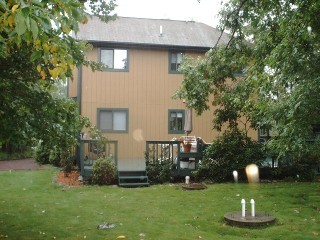
4) Safety, Repair/Replace - One or more deck ledger boards are nailed to the structure rather than being attached by adequate fasteners. This poses a significant safety hazard since the ledger board(s) may separate from the structure, causing the deck(s) to collapse. A qualified contractor should install lag screws or bolts as per standard building practices to securely attach the ledger board(s) to the structure. For more information on installing deck ledger boards visit: http://www.hometime.com/Howto/projects/decks/deck_4.htm
And for more information on building safe decks in general, visit: http://www.thisoldhouse.com/toh/knowhow/exteriors/article/0,16417,212625,00.html
And for more information on building safe decks in general, visit: http://www.thisoldhouse.com/toh/knowhow/exteriors/article/0,16417,212625,00.html
5) Safety, Repair/Replace - One or more flights of stairs with more than two risers have no handrail installed. This is a safety hazard. A qualified contractor should install graspable handrails that your hand can completely encircle at stairs where missing, and as per standard building practices.
6) Safety, Repair/Replace - One or more exterior electric receptacles aren't GFCI protectected or rated for use in wet areas. This is a safety hazard due to the risk of shock and fire. Repairs should be made as necessary, and by a qualified electrician if necessary, so all exterior receptacles are waterproof as per standard building practices.
7) Repair/Maintain - Vegetation such as trees, shrubs and/or vines are in contact with or less than one foot from the structure's exterior. Vegetation can serve as a conduit for wood destroying insects and may retain moisture against the exterior after it rains. Vegetation should be pruned and/or removed as necessary to maintain a one foot clearance between it and the structure's exterior.
Roof
11) Maintain - Trees are overhanging roof and are within 10 feet of roof vertically. This is a conducive condition for wood destroying insects and organisms since organic debris such as leaves or needles are more likely to accumulate on the roof surface. Accumulated debris may cause water to enter gaps in the roof surface and leak into attic and/or interior spaces. Trees should be pruned so they are at least 10 feet above roof, or don't overhang the roof.
Electric service
12) Safety, Repair/Replace, Evaluate - One or more overcurrent protection devices (circuit breakers) are "double tapped", where 2 or more wires are clamped in a terminal designed for only one wire. This is a safety hazard since the bolt or screw may tighten securely against one wire, but leave others loose. Arcing, sparks and fires may result. A qualified electrician should evaluate and repair as necessary.
13) Safety, Repair/Replace - The service drop wires are in contact with trees or vegetation. Recommend having a qualified tree service company or arborist prune or remove trees as necessary to prevent straining or abrading the service drop wires.
Crawl space
21) Repair/Replace, Evaluate - Standing water was found in one or more sections of the crawl space. Accumulated water is a conducive condition for wood destroying insects and organisms and should not be present in the crawl space. A qualified contractor who specializes in drainage issues should evaluate and repair as necessary. Typical repairs for preventing water from accumulating in crawl spaces include:
Ideally, water should not enter crawl spaces, but if water must be controlled after it enters the crawl space, then typical repairs include installing trenches, drains and/or sump pump(s) in the crawl space.
- Repairing, installing or improving rain run-off systems (gutters, downspouts and extensions or drain lines)
- Improving perimeter grading
- Repairing, installing or improving underground footing and/or curtain drains
Ideally, water should not enter crawl spaces, but if water must be controlled after it enters the crawl space, then typical repairs include installing trenches, drains and/or sump pump(s) in the crawl space.
22) Repair/Replace - One or more crawl space vent screens are blocked by soil, debris, insulation, stored items or removable panels. This restricts ventilation in the crawl space and may result in increased levels of moisture inside. Materials or items blocking vents should be removed.
Recommend cutting styrofoam insulation away from the vents in the crawl space area so there is proper ventilation to help keep moisture levels down in crawl space area.
Recommend cutting styrofoam insulation away from the vents in the crawl space area so there is proper ventilation to help keep moisture levels down in crawl space area.
Kitchen
26) Safety, Repair/Replace, Evaluate - One or more electric receptacles that serve countertop surfaces within six feet of a sink appear to have no ground fault circuit interrupter (GFCI) protection. This is a safety hazard due to the risk of shock. A qualified electrician should evaluate to determine if GFCI protection exists, and if not, repairs should be made so that all receptacles that serve countertop surfaces within six feet of sinks have GFCI protection. For example, install GFCI receptacles or circuit breaker(s) as needed.
27) Repair/Maintain - Caulk is missing and/or deteriorated where countertops meet backsplashes in wet areas, such as around sinks. Caulk should be replaced where deteriorated and/or applied where missing to prevent water damage.
Bathrooms
28) Repair/Replace, Evaluate - One or more exhaust fans are noisy or vibrate excessively. A qualified contractor should evaluate and replace the fan(s) or make repairs as necessary.
29) Repair/Replace, Evaluate - One or more toilets are loose. A qualified contractor should remove the toilet(s) for further evaluation and repairs if necessary. A new wax ring should be installed and toilet(s) should be securely anchored to the floor to prevent movement and leaking.
30) Repair/Maintain - Caulk is missing and/or deteriorated at one or more showers. For example, where the shower base meets the floor below and/or around the shower surround. Caulk should be replaced where deteriorated and/or applied where missing to prevent water intrusion and damage to wall and floor structures.
Interior rooms
32) Safety, Repair/Replace, Evaluate - Evidence of "light to moderate" rodent infestation was found in one or more areas. The Center for Disease Control (CDC) defines this as less than 20 feces per square foot. Rodent infestation may be a safety hazard due to the risk of contracting Hantavirus Pulmonary Syndrome (HPS). HPS is a rare (only 20-50 cases per year in the United states) but deadly (40% mortality rate) disease transmitted by infected rodents through urine, droppings, or saliva. Humans can contract the disease when they breathe in aerosolized virus. For example, from sweeping up rodent droppings.
Recommend following guidelines in the CDC's Clean Up, Trap Up, Seal Up article for eradicating rodents, cleaning up their waste and nesting materials, and preventing future infestations. While Hanta virus is believed to survive less than one week in droppings and urine, specific precautions should be taken during clean up. The client(s) may wish to consult with a qualified, licensed pest control operator for eliminating the infestation. A qualified licensed abatement contractor or industrial hygenist could be contacted for clean up. If the infestation was minimal, clean up of rodent waste and nesting materials in non-living spaces (crawl spaces and attics) may not be necessary, or may be performed for aesthetic reasons only (odor and appearance).
Recommend following guidelines in the CDC's Clean Up, Trap Up, Seal Up article for eradicating rodents, cleaning up their waste and nesting materials, and preventing future infestations. While Hanta virus is believed to survive less than one week in droppings and urine, specific precautions should be taken during clean up. The client(s) may wish to consult with a qualified, licensed pest control operator for eliminating the infestation. A qualified licensed abatement contractor or industrial hygenist could be contacted for clean up. If the infestation was minimal, clean up of rodent waste and nesting materials in non-living spaces (crawl spaces and attics) may not be necessary, or may be performed for aesthetic reasons only (odor and appearance).
33) Repair/Replace - One or more doors will not latch when closed. and bottom of door drags on the floor or carpet, Repairs should be made as necessary, and by a qualified contractor if necessary. For example, aligning strike plates with latch bolts and/or replacing locksets.
34) Monitor - Stains were found in one or more ceiling areas. However, no elevated levels of moisture were found. The stain(s) may be due to past roof and/or plumbing leaks. Recommend asking the property owner(s) about this, and monitoring the stained area(s) in the future, especially after heavy or prolonged rain. If elevated moisture is found in the future, a qualified contractor should evaluate and repair as necessary.