| SAMPLE Inspection Report | |
| Client(s): | Omitted |
| Property address: | Omitted |
| Inspection date: | Thursday, December 06, 2007 |
This report is the exclusive property of INSPEC and the client(s) listed in the report title.
INSPEC will NOT release this report to any individual or entity without written permission of its client.
Use of this report by any unauthorized persons is prohibited.
A home inspection is not a pass/fail test, nor will an inspector return to verify that defects were corrected.
Defects noted within this report are in comparison to what is considered as ideal by the housing industry. Personal safety of occupants and structural integrity of the home are front of mind during evaluation.
![]() | Safety | Poses a potential risk of injury or death |
![]() | Major defect | Correction likely involves a significant expense |
![]() | Repair/Replace | Recommend repairing or replacing |
![]() | Repair/Maintain | Recommend repair and/or maintenance |
![]() | Minor defect | Correction likely involves only a minor expense |
![]() | Maintain | Recommend ongoing maintenance |
![]() | Evaluate | Recommend evaluation by a specialist |
![]() | Monitor | Recommend monitoring in the future |
![]() | Comment | For your information |
Click here for a glossary of building construction terms.
Contact your inspector if there are terms that you do not understand, or visit the glossary of construction terms at http://www.reporthost.com/glossary.aspTable of Contents
General information
Grounds
Exterior
Roof
Shed
Attic
Electric service
Water heater
Heating
Plumbing and laundry
Fireplaces, woodstoves and chimneys
Basement
Kitchen
Bathrooms
Interior rooms
| General information | Return to table of contents |
| Grounds | Return to table of contents |
| Exterior | Return to table of contents |

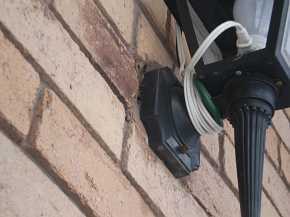
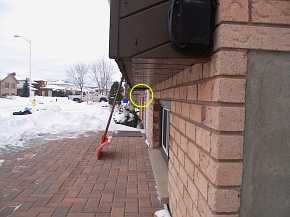
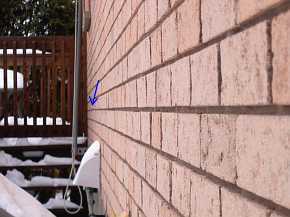
One or more wall-mounted exterior light fixtures have wiring that's subject to water intrusion due to caulk not being installed around the light fixture's back plate. Caulk should be applied around the perimeter of back plates where missing. A gap should be left at the bottom for condensation to drain out.
![]() Photo 2 |

One or more outside faucets are missing backflow prevention devices. These devices reduce the likelihood of polluted or contaminated water entering the potable water supply. This condition can occur when an outside faucet is left in the "on" position with a hose connected and the sprayer head turned off. When pressure in the system fluctuates, water can be drawn back into the water supply pipes from the house. If a chemical sprayer is being used with the hose, those chemicals can enter the water supply pipes. 
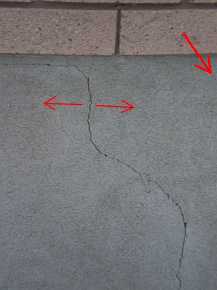
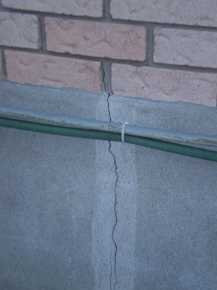
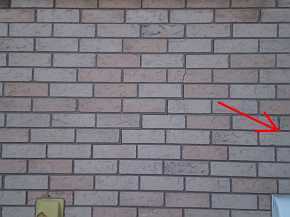
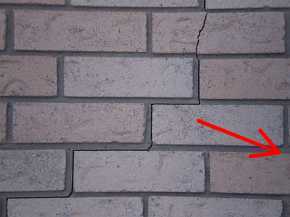
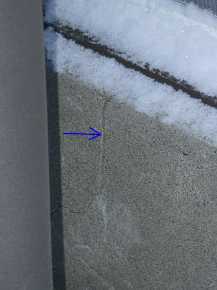
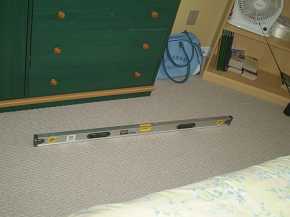
The structure appears to be experiencing what is known as differential settlement. This occurs when a portion of the structure settles more than another portion of the same structure. This is most commonly caused by: under-sized footing, poor soil compaction, undermining of soil under footings or breaks in the weeping system. The sump pit was evaluated for sand accumulation. All was fine there.
One or more deck structures are attached to the home and bears on non-footed blocks or pads resting on the ground.
One or more downspouts have no extensions, or have extensions that are ineffective. This can result in water accumulating around the structure's foundation, or in basements and crawl spaces if they exist. Accumulated water is a conducive condition to insects and organisms, and may also cause the foundation to settle and possibly fail over time. Repairs should be made as necessary, such as installing or repositioning splash blocks, or installing and/or repairing tie-ins to underground drain lines, so rain water is carried at least several feet away from the structure to soil that slopes down and away from the structure.
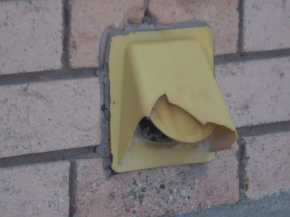
One or more exhaust duct end caps are damaged and/or deteriorated. Their purpose is to prevent unconditioned air from entering the house, and keep out birds, rodents and bugs. Blocked ducts can cause fan motors and/or clothes dryers to overheat and may pose a fire hazard. New vent cap(s) should be installed where necessary.
![]() Photo 5 |
| Roof | Return to table of contents |

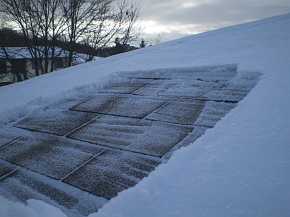
Although only a small portion of the fully snow-covered roof was cleared, the asphalt shingle roofing material could be dated just the same. The cleared portion appears to indicate the shingle are newer and not original.![]() Photo 10 |
The roof was completely obscured by snow and couldn't be fully evaluated.
| Shed | Return to table of contents |
The shed appeared to be in good form.
| Attic | Return to table of contents |
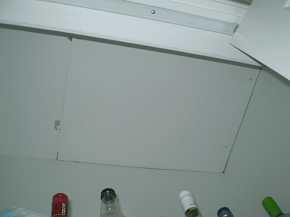
The attic access hatch was inaccessible due to the hatch being permanently closed. The inspector was unable to evaluate the attic space, and it is excluded from this inspection. ![]() Photo 12 |
| Electric service | Return to table of contents |
Wire exiting electrical boxes of any kind must be attached to the surrounding structure within 12" from the box.| Water heater | Return to table of contents |

The last service date of this system appears to be more than one year ago. The client(s) should ask the property owner(s) when it was last serviced. Either rented or owned water heaters need servicing and cleaning to ensure optimal and safe operation. If unable to determine the last service date, or if this system was serviced more than one year ago, a qualified heating and cooling contractor should inspect, clean, and service this system, and make repairs if necessary. For safety reasons, and because this system is fueled by gas or oil, this servicing should be performed annually in the future. For more information visit: http://www.cpsc.gov/CPSCPUB/PREREL/prhtml05/05017.html
Sediment acculates at the bottom of water heaters, this sediment is sometimes disturbed by gusts of water usage leading to murky water at times.
The water heater was operated successfully.
| Heating | Return to table of contents |
A plug-in type CO detector is installed at this property.
Also see “Interior Rooms"
| Plumbing and laundry | Return to table of contents |


No ground fault circuit interrupter (GFCI) protection device is visible for the sump pump electric supply. A qualified electrician should determine if a GFCI protection device (receptacle or circuit breaker) exists for the sump pump and install one if missing to reduce the danger of electric shock.

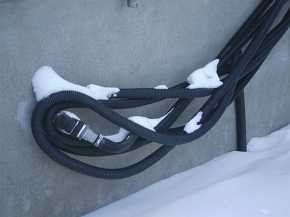
The sump pump drain is much too long and discharges near the foundation wall. This defeats the purpose all together since water will easily return to the weeping system. Furthermore, the curled-up drin line will freeze and block.![]() Photo 4 |
The laundry sink is not anchored to the wall or floor. A qualified contractor should securely anchor the sink to the wall and/or floor to prevent damage to and leaks in the water supply and/or drain pipes due to the sink being moved.
The sump pump appeared to be inoperable. This is a conducive condition for water accumulation. A qualified contractor should evaluate and repair as necessary.
The main water shut-off valve serves as an emergency stop for the pressurized water supply system. An improperly working main valve could lead to worse water damage should a pipe burst for example.
Drains are provided with "P-traps" (downward u-shaped bend in the pipe below) that are designed to hold a small amount of water in the drain pipe. this water prevents sewer gases from entering the living space from drain pipes.
Garden hose bibs installed at the exterior need to be bled (removing water from the exterior portion of the water pipe) prior to cold weather each year. Follow these steps to bleed such bibs;
Neither the clothes washer nor dryer were operated or evaluated. They are excluded from this inspection.
A sump pump is installed on the premises. This may indicate that water accumulates inside or below the structure. Recommend asking the property owners how often the sump pump operates and for how long at different times of the year. Also, the clients should be aware that the service life of most sump pumps is between five and seven years, and that the pump may need replacing soon depending on its age and how much it operates.| Fireplaces, woodstoves and chimneys | Return to table of contents |
The glass on one or more gas fireplaces and/or stoves has a hazy film. This is typically a mineral residue left from water vapor as the gas burns. It may be possible to clean this fogging by removing the glass from the fireplace and using a gas appliance ceramic glass cleaner, available through gas fireplace and stove distributors and installers. Ammonia-based products, such as common glass cleaners should not be used since they may cause damage or etching to the glass, or make the haze permanent.
The fireplace was operated successfully.
| Basement | Return to table of contents |


One or more electric receptacles and/or the boxes they are installed in are loose and/or not securely anchored. Wire conductors may be damaged due to repeated movement and/or tension on wires, or insulation may be damaged. This is a safety hazard due to the risk of shock and fire. A qualified electrician should evaluate and repair as necessary.

Cover plate(s) are broken at one or more electrical boxes, such as for receptacles, switches and/or junction boxes. They are intended to contain fire and prevent electric shock from exposed wires. This is a safety hazard due to the risk of fire and shock. Cover plates should be replaced where necessary.
Part of the basement floor is built-up with a sub-floor and could not be evaluated.| Kitchen | Return to table of contents |


One or more electric receptacles that serve countertop surfaces within six feet of a sink appear to have no ground fault circuit interrupter (GFCI) protection. This is a safety hazard due to the risk of shock. A qualified electrician should evaluate to determine if GFCI protection exists, and if not, repairs should be made so that all receptacles that serve countertop surfaces within six feet of sinks have GFCI protection. For example, install GFCI receptacles or circuit breaker(s) as needed.
| Bathrooms | Return to table of contents |

One or more exhaust fans is inoperable or provides inadequate air flow. Moisture may accumulate as a result. A qualified contractor should evaluate and replace the fan or make repairs as necessary.
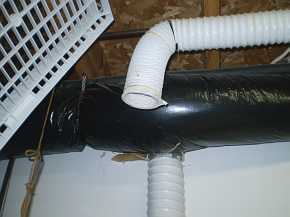
The basement bathroom exhaust fan is terminated within the basement laundry room.![]() Photo 11 |
Caulk is missing or deteriorated around the base of one or more bathtub spouts. It should be replaced where deteriorated and/or applied where missing to prevent water intrusion and damage to wall structures.
The basement bathroom was in good form.
| Interior rooms | Return to table of contents |


One or more electric baseboard heaters are installed with an electric receptacle located above. Insulation on appliance cords in contact with the heater(s) may be damaged by the heat. This is a safety hazard due to the risk of shock and fire. A qualified electrician should evaluate and make repairs as necessary. For example, converting receptacles to junction boxes, moving receptacles and/or moving baseboard heaters.


One or more electric receptacles and/or the boxes they are installed in are loose and/or not securely anchored. Wire conductors may be damaged due to repeated movement and/or tension on wires, or insulation may be damaged. This is a safety hazard due to the risk of shock and fire. A qualified electrician should evaluate and repair as necessary.
The Heat Recovery Ventilator (HRV) is in need of cleaning. Much debris and insects can accumulate in the unit, reducing flow though the unit's filter.
Note: In order to prevent cold spots at exterior walls, be sure to keep items and furniture at least 3” away from exterior walls.
Some wall, floor and/or ceiling surfaces were obscured by furniture and/or stored items. Some areas couldn't be evaluated.
![]() Photo 1 |