Washington State Home Inspector License # 554 WSDA Structural Pest Inspector License # 78889
Property Inspection Report Unofficial version!
Client(s):
Sample two
Property address:
Granite Peak Inspection
Inspection date:
Thursday, January 17, 2013
This report published on Thursday, October 12, 2023 9:09:33 AM PDT
View summary page Granite Peak Inspection, Inc. Bradley E Gotham, President Washington Sate licensed home Inspector #554 Washington State Structural Pest Inspector License number 78889
Thank you for using Granite Peak Inspection, Inc. for your home inspection. I know your home inspection is very important to you, and your business is very important to me. If I can help in anyway after the inspection, please call or email me at the email address or telephone number provided on this report. If you are happy with Granite Peak Inspection, Inc. please refer my company to your friends, your realtor and anyone you believe could benefit from my services. Granite Peak Inspection, Inc. not only performs inspections for purchasers, but also for people planning to sell a home who wish to estimate the amount of work that needs to be completed before listing the house.
A home inspection is a visual, and not an exhaustive or invasive, inspection of a home by a trained and impartial inspector. Your Granite Peak inspection adheres to the standards of the State of Washington.
This report includes an inspection for wood destroying organisms (WDO'S). More detailed information on this topic, and a suggestion as to how to more effectively use Form 17, the Real Property Transfer Disclosure Statement, is provided under general information. By law the State of Washington mandates that I inspect for, and report on, WDO infestations or conditions that are conducive to attracting WDO's.
Every Granite Peak Inspection, Inc. report includes photos and descriptions detailing the locations of areas of concern as noted by the inspector. Despite the photos and specific information provided, if during this inspection wood destroying organisms or conditions conducive to wood destroying organisms were found, I want you to know: WAC 16-228-2045 REQUIRES THAT A DIAGRAM BE PREPARED FOR WDO INSPECTION REPORTS. A COPY IS AVAILABLE UPON REQUEST.
SUMMARY: NEAR THE TOP OF THE REPORT YOU MAY CLICK ON A "SUMMARY". THIS WILL SHOW ONLY THE MOST SIGNIFICANT ISSUES WHICH ARE TAKEN FROM THE MAIN REPORT BASED ON PRIORITY. THE SUMMARY LEAVES CONCERNS NUMBERED AS THEY ARE IN THE FULL REPORT, SO THEY ARE EASY TO LOCATE IN THE BODY OF THE REPORT. FOR THIS REASON, THE SUMMARY WILL PROBABLY NOT BE SEQUENTIALLY NUMBERED
How to Read this Report
This report is organized by the property's functional areas. Within each functional area, descriptive information is listed first and is shown in bold type. Items of concern follow descriptive information.
Concerns are shown and sorted according to these types:
Cautionary
A recommendation to enhance safety. Not necessarily urgent.
Repair/Replace
Recommend repairing or replacing
Repair/Maintain
Recommend repair or maintenance
Minor defect
A minor concern
Maintain
Recommend ongoing maintenance
Evaluate
Client to determine level of personal concern or, if noted, consult with a specialist.
Monitor
Recommend monitoring in the future
Comment
For your information
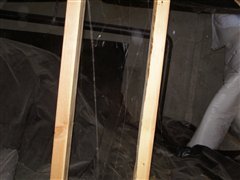
Damage
Damage caused by wood destroying insects or organisms (Rot, carpenter ant galleries, etc.)
Conducive conditions
Conditions conducive for wood destroying insects or organisms (Wood-soil contact, shrubs in contact with siding, roof or plumbing leaks, etc.)
Click here for a glossary of building construction terms.Contact your inspector If there are terms that you do not understand, or visit the glossary of construction terms at https://www.reporthost.com/glossary.asp
Age of building: Build date is listed 2004 according to the MLS
Time started: 12:45 pm
Time finished: 4:00 pm
Inspection Fee: 400.00
Payment method: Cash
Present during inspection: Client
Occupied: No
Weather conditions: Clear
Temperature: Cold 36 Degrees
Ground condition: Frozen
Front of structure faces: West
Main entrance faces: West
Foundation type: Finished basement, Crawlspace
The following items are excluded from this inspection:: irrigation system, shed
1) Comment - A home inspection is a visual, and not an exhaustive or invasive inspection of a home by a trained and impartial inspector. Due to the inherent nature of construction, the inspector cannot see through or into interior walls or siding, through or into concrete slabs or floors, insulation, carpets, roofs and ceilings or down into the soil. Also, a home inspector may not be able to access some areas, due to inadequate clearances or safety hazards. A home inspector, by necessity, is looking for significant issues and not minor or primarily aesthetic concerns. Therefore, it is recommended that the buyer also pursue due diligence of his or her own, such as studying Form 17.
Form 17 is required on all real estate transactions conducted in the State of Washington. Granite Peak Inspection, Inc. encourages you to read Form 17, as it is frequently not provided to the home inspector. This crucial disclosure consists of about eighty questions pertaining to the home. By law, a seller is required to disclose on this form many details about the home and property, which may or may not be observable at the time of inspection. For example, the seller's disclosure could reveal hidden but known defects in materials or products used in construction of the home; well or water supply problems; known health or environmental concerns such as mold, underground fuel storage tanks, chemical pollutants, or a history of seasonal water, flooding, pest infestations or fire damage, etc. -------------------------------------------------------------------------------- Wood Destroying Organisms: The wood destroying organism (WDO) inspection on the home is a good faith effort by the inspector to report the visual signs of WDO infestations. "Conducive conditions", deficiencies at the home or on the premises that can contribute to the likelihood of WDO infestations, will also be reported. Although a serious effort is made, it is not always possible to locate every WDO or conducive condition that may be present at a home. Furthermore, the report only refers to issues seen at the home at the time of the inspection.
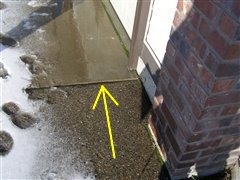
2) Cautionary, Repair/Replace, Evaluate - One possible trip hazard was found in the driveway/sidewalk near the south side of the garage door due to heaving. Recommend if desired by the client having a qualified contractor evaluate and repair or replace driveway sections as necessary to eliminate trip hazards.
Photo 2-1 Slightly Heaved slab south side of driveway.
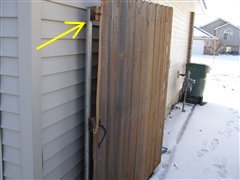
3) Repair/Replace, Evaluate - Gate hinges are damaged on the north side of the home. A qualified contractor should evaluate and make repairs as necessary to the gate hinge.
Photo 3-1 Damaged gate hinge north side of the home
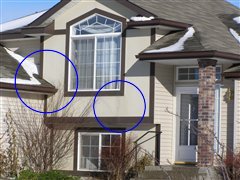
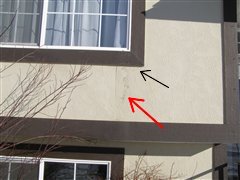
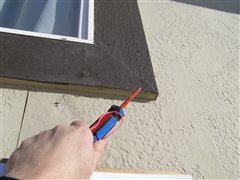
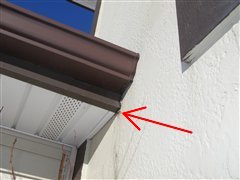
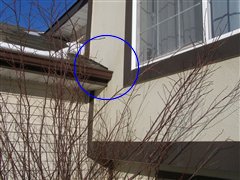
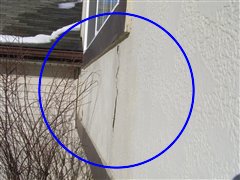
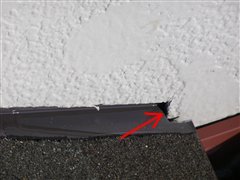
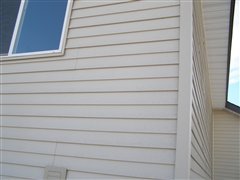
4) Repair/Replace, Damage, Conducive conditions - While on site the inspector noticed that in two areas at the front of the home where the siding, trim and fascia boards have been exposed to water run off due to leaking rain gutters and substandard flashings. This water appears to be on the siding surface and flowing behind the siding, and as a result the siding has water damage and coating loss. The trim boards are also damaged and are starting to rot. Recommend a qualified contractor with experience in siding installation, roof flashing and gutter repair evaluate these areas by removing the damaged siding and trim and replacing, as well as evaluate any possible damage that may have occurred to the substructure below.
Photo 4-1 Areas of concern at the front of the home. Photo 4-2 Black arrow: wood rot at window trim board. Red arrow: water damaged siding.
Photo 4-3 Wood rot at window trim board. Photo 4-4 Water from roof running down siding behind gutter cap.
Photo 4-5 Leakage at north side of window. Photo 4-6 Damaged siding
Photo 4-7 Trim board too close to the roofing and wicking up water resulting in wood decay and rot. Photo 4-8 Substandard flashing missing "kick out flashing" leak path
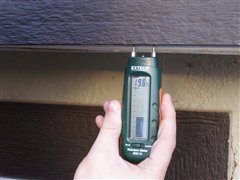
Photo 4-9 Close up of substandard flashing. Arrow shows leak path behind siding and damaged siding. Kick out flashing should be installed at this area. Photo 4-10 Trim board below window 19.8 % moisture. Excessive moisture is a conducive to wood destroying organisms.
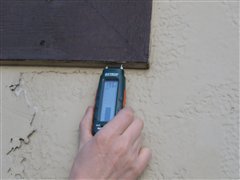
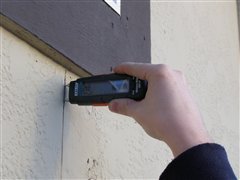
Photo 4-11 Trim board below window 19.6 % moisture Photo 4-12 Siding below window south side 21.0 % moisture. Excessive moisture is a conducive to wood destroying organisms.
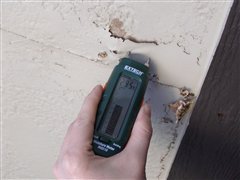
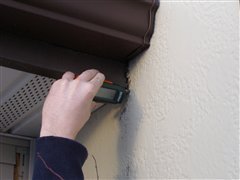
Photo 4-13 Siding at north side of window 29.5% moisture; notice vegetation growing on siding to the right of the meter. Excessive moisture is a conducive to wood destroying organisms. Photo 4-14 Under gutter 18.8 % moisture. Excessive moisture is a conducive to wood destroying organisms.
5) Repair/Replace, Conducive conditions - End caps of the garage gutters were leaking during the inspection. This can result in water accumulating on the home's exterior and around the structure's foundation, or in basements and crawl spaces. Accumulated water is a conducive condition to wood destroying insects and organisms, and may also cause the foundation to settle and possibly fail over time. A qualified contractor should replace or repair gutters where necessary.
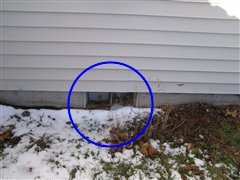
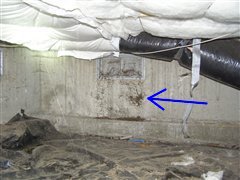
6) Repair/Replace, Conducive conditions - The crawlspace vents on the south side of the home are near grade with no well provided to prevent rainwater from entering the interior crawl space. This can lead to water entering and accumulating in the crawl space, and is a conducive condition for wood destroying insects and organisms. A qualified contractor should install wells where necessary.
Photo 6-1 Crawl space vents near soil grade Photo 6-2 Inside crawl space stains from of water entrance into the area.
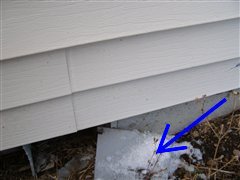
7) Repair/Replace - One or more crawl space vent doors are damaged. Recommend a qualified contractor repair the vent door to keep cool air from entering the crawl space during the winter months.
Photo 7-1 Damaged crawl space vent louver.
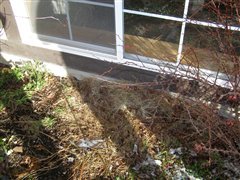
8) Repair/Maintain, Conducive conditions - Soil is in contact with or less than six inches from siding and/or trim. This is a conducive condition for wood destroying insects and organisms. Soil should be graded and/or removed as necessary so there are at least six inches of space between the siding and trim and the soil below.
Photo 8-1 Soil in contact with basement window wood trim.
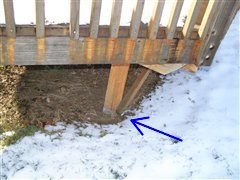
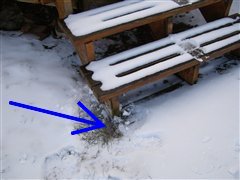
9) Repair/Maintain, Conducive conditions - One or more wooden deck support posts and steps are in contact with soil. This is a conducive condition for wood destroying insects and organisms. However, no damage from wood destroying insects or organisms was found. Standard building practices require that there be at least 6" of space between any wood and the soil below, even if the wood is treated. If possible, soil should be removed or graded so a 6" clearance is maintained. Otherwise recommend installing borate based Impel rods to prevent rot. For more information, visit: http://www.google.com/search?q=impel+rods
Photo 9-1 Wood to soil contact at rear deck support posts. Photo 9-2 Wood to soil contact at rear deck steps.
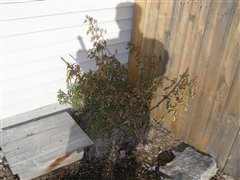
10) Minor defect, Conducive conditions - Vegetation such as shrubs and flowers are in contact with or less than one foot from the structure's exterior in a few locations. Vegetation can serve as a conduit for wood destroying insects and may retain moisture against the exterior after it rains. Recommend vegetation be pruned and/or removed as necessary to maintain a one foot clearance between it and the structure's exterior.
Photo 10-1 Vegetation such as shrubs and flowers are in contact with the homes siding.
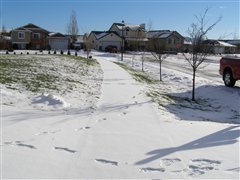
11) Comment - Snow covered most of the driveway and sidewalks, so the inspector was unable to fully evaluate these areas and they are excluded from the inspection.
Photo 11-1 Front driveway and sidewalks were covered with snow. Photo 11-2 sidewalk's covered with snow.
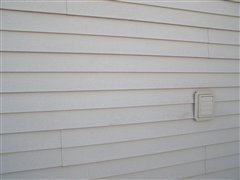
12) - The vinyl siding has dark spots on it in some areas. The inspector is unsure of the cause, but these stains can be removed when rubbed with a finger. Recommend asking the owner about these and power washing the siding if desired by the client.
Roof inspection comments: The following items or areas are not included in this inspection: areas that could not be traversed or viewed clearly due to lack of access; solar roofing components. Any comments made regarding these items are made as a courtesy only. Note that the inspector does not provide an estimate of remaining life on the roof surface material, nor guarantee that leaks have not occurred in the roof surface, skylights or roof penetrations in the past. Regarding roof leaks, only active leaks, visible evidence of possible sources of leaks, and evidence of past leaks observed during the inspection are reported on as part of this inspection. The inspector does not guarantee or warrant that leaks will not occur in the future. Complete access to all roof and attic spaces during all seasons and during prolonged periods of all types of weather conditions (e.g. high wind and rain, melting snow) would be needed to do so. Regarding the roof drainage system, unless the inspection was conducted during and after prolonged periods of heavy rain, the inspector was unable to determine if gutters, downspouts and extensions performed adequately or were leak-free.
Roof inspection method: Traversed
Roof type: Cross gable
Roof covering: Asphalt or fiberglass composition shingles
Estimated age of roof: 6 years
Gutter & downspout material: Aluminum
Roof ventilation: Adequate
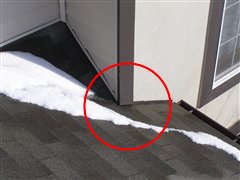
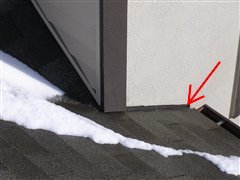
13) Repair/Replace, Conducive conditions - The trim on one or more exterior walls above lower roof sections is in contact with or has less than a one inch gap between it and the roof surface below. A gap of at least one inch is recommended so water isn't wicked up into the trim board from the shingles below, and also to provide room for additional layers of roofing materials when the current roof surface fails. Recommend having a qualified contractor make repairs as necessary, such as trimming trim boards, so at least a one inch gap exists between the siding and the roofing below where necessary.
Photo 13-1 Trim board too close to the roofing and wicking up water resulting in wood decay and rot.
14) Maintain, Monitor, Conducive conditions - Two sections of roof surfaces are sloped towards each other. Debris such as leaves or needles are more likely to accumulate in this area than rest of the roof. Leaks may occur as a result. Recommend monitoring such areas for accumulated debris in the future and cleaning as necessary.
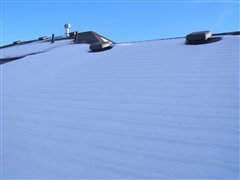
15) Comment - The roof was partially obscured by snow and couldn't be fully evaluated.
Photo 15-1 Photo 15-2 the eastside of the roof was covered with snow
Fire rating: As a home inspector, I do not evaluate or measure the fire rating of the dry wall/plaster in the garage and the house. Different townships require different ratings. Ideally, there should be 5/8-inch type X drywall or equivalent on walls and ceiling that separate the garage from habitable rooms. and a 20 minute fire rated door separating the house and garage. I do check for breaches in the fire wall.
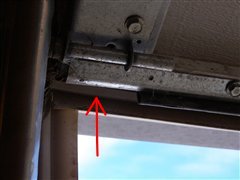
16) Repair/Replace - Weatherstrip at the bottom of the vehicle door is missing. It should be installed where missing to prevent water and vermin intrusion.
Photo 16-1 Gap in the weather strip at the bottom left hand side of the garage door.
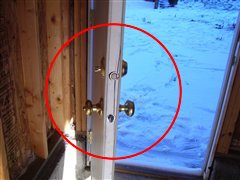
17) Repair/Replace - The exterior entrance door has been forced open and is damaged and should be repaired or replaced by a qualified contractor.
Photo 17-1 Garage door is damaged, appears to have been kicked in.
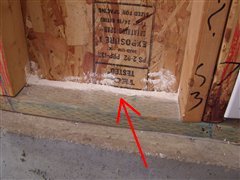
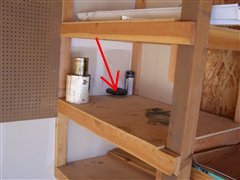
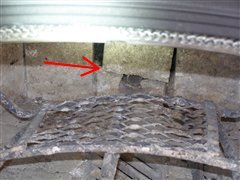
18) Comment - An unknown white powder was found on the sill plate of the garage wall. Ask the owner about this and if the home was possibly treated for wood destroying insects such as ants.
Photo 18-1
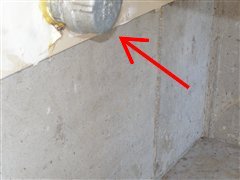
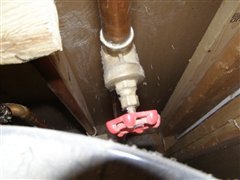
19) - The inspector located pipes that extend into the garage that are likely a water supply and drain. Recommend asking the seller about these and their function(s).
Photo 19-1 Possible Drain line? Photo 19-2 Supply lines?
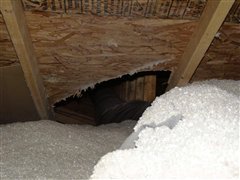
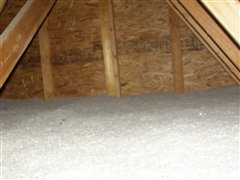
20) Comment - Some attic areas were inaccessible due to lack of permanently installed walkway and the possibility of damage to insulation due to compaction if walked upon. These areas are excluded from this inspection.
Photo 20-1 Attic space towards front Photo 20-2 "blown in" insulation
Electrical Inspection comment: As a home inspector and not a licensed electrician, if I feel it is safe enough to do, so I will open the electrical panel and check interior components of the of service panels and sub panels, the conductors and the over-current protection devices. Inside the house I will check a representative number of installed lighting fixtures, receptacles and switches. This is not an exhaustive inspection of every component and installation detail. There will be receptacles and switches and lights that I will not have time to inspect. Ask owners about all of the wall switches. Electricity and electrical work can be hazardous, therefore I aways recommend electrical work be performed by a licensed electrician. It is essential that any recommendation that I may make for a licensed electrician to repair or evaluate should be completed before the close of escrow, because an electrician could reveal other problems or recommend repairs.
Primary service type: Underground
Primary service overload protection type: Circuit breakers
Service amperage (amps): 200
Service voltage (volts): 120/240
Location of main service switch: In garage on the north wall
Location of sub panels: Wired for 220 on the south exterior wall of the home.
Location of main disconnect: Breaker at bottom of main service panel
Service entrance conductor material: Aluminum
System ground: Ground rod(s) in soil
Main disconnect rating (amps): 200
Branch circuit wiring type: Non-metallic sheathed
Solid strand aluminum branch circuit wiring present: No
Smoke detectors present: Yes
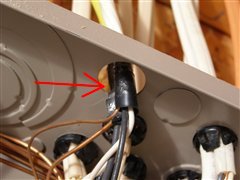
21) Cautionary, Repair/Replace - Two bushings are missing from where wires enter holes in the main service panel. This is a safety hazard as the wiring insulation can be cut or abraded on the metal edge of the hole(s). A qualified electrician should install bushings where missing.
Photo 21-1 Bushings are missing at top of panel.
22) Cautionary, Minor defect - One screw is missing from the main service panel cover and should be replaced. Because energized wiring may exist behind the holes with the missing screws, recommend that a qualified, licensed electrician replace these screws, or that care be taken to ensure that the new screws do not come in contact with wiring inside the panel when they are installed. Stock screws from the panel manufacturer should be used, or their equivalent.
23) Cautionary - Washington State home inspection standards require me to notify you of the following. No arc fault circuit interrupter (AFCI) breakers or outlets were installed for bedroom circuits. These are relatively new devices, and reduce the risk of fire by protecting against overheated or arcing receptacles (outlets) or light fixtures. Consult with a qualified electrician about upgrading circuits to AFCI protection per standard building practices. What’s an AFCI device? In short, it’s an electrical safety device designed to prevent fires. It looks and acts a lot like a GFCI device in that it has a test button and a reset method, but GFCI devices are designed to prevent people from getting electrocuted, not prevent fires. For an excellent document explaining the functionality of AFCIs as well as the history of these devices, click here: AFCIs Come of Age.
24) Cautionary - No carbon monoxide alarms were visible. This is a potential safety hazard. As of 2012 Washington State requires CO alarms to be installed for new construction and/or for homes being sold. Recommend installing approved CO alarms outside of each separate sleeping area in the immediate vicinity of the bedrooms on each level and in accordance with the manufacturer's recommendations. For more information, visit: http://www.cpsc.gov/CPSCPUB/PREREL/prhtml05/05017.html
HVAC inspection: As a home inspector, the inspection of the heating system is a visual inspection and not technically exhaustive. A detailed evaluation of the interior components of the heating system is beyond the scope of a home inspection. It is essential that any recommendation that is made for service, correction, or repair be scheduled prior to closing or purchase of the property, because the hired professional could reveal defects or recommend further repairs that could effect your evaluation of the property.
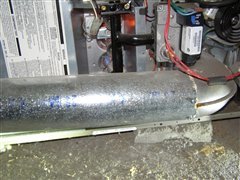
25) Cautionary, Repair/Maintain, Evaluate - The inspector was unable to determine the last service date. The client should ask the property owner when it was last serviced. If unable to determine the last service date, or if this system was serviced more than one year ago, a qualified heating and cooling contractor should inspect, clean, and service this system, and make repairs if necessary. For safety reasons, and because this system is fueled by gas or oil, this servicing should be performed annually in the future. For more information visit: http://www.cpsc.gov/CPSCPUB/PREREL/prhtml05/05017.html
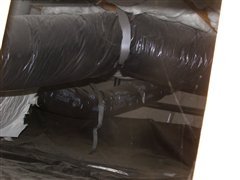
26) Repair/Replace - One of the straps supporting heating/cooling duct work is broken. Permanent repairs should be made by a qualified contractor so ducts are adequately supported.
Limitations: Evaluation of and determining the adequacy or completeness of the following items are not included in this inspection: water recirculation pumps; solar water heating systems; Energy Smart or energy saver controls; catch pan drains. Any comments made regarding these items are as a courtesy only. Note that the inspector does not provide an estimate of remaining life on water heaters, does not determine if water heaters are appropriately sized, or perform any evaluations that require a pilot light to be lit or a shut-off valve to be operated.
Condition of water heater: Appeared serviceable
Type: Tank
Energy source: Natural gas
Estimated age: Manufactured 2002
Temperature-pressure relief valve installed: Yes
Manufacturer: American
Model number: 123456
Serial number: 2002
Location of water heater: Basement
Hot water temperature tested: Yes
Water temperature (degrees Fahrenheit): 130
28) Cautionary, Repair/Replace - The water heater did not have earthquake straps or struts installed. This is a potential safety hazard in the event of an earthquake due to the risk of the water heater tipping over, gas lines breaking if it's gas-fired, or electric wiring being damaged if powered by electricity. Leaks can also occur in water-supply pipes. Recommend that a qualified person install earthquake straps or struts as necessary and per standard building practices.
29) Cautionary - The hot water temperature was greater than 120 degrees Fahrenheit. This is a safety hazard due to the risk of scalding. The thermostat should be adjusted so the water temperature doesn't exceed 120 degrees. If the water heater is powered by electricity, a qualified person should perform the adjustment, since covers that expose energized equipment normally need to be removed. For more information on scalding dangers, visit: http://www.cpsc.gov/CPSCPUB/PUBS/5098.pdf
30) Comment - Although functional at the time of the inspection, the estimated useful life for most water heaters is 8-12 years. This water heater appeared to be at this age and/or its useful lifespan and may need replacing at any time. Recommend budgeting for a replacement in the near future, or considering replacement now before any leaks occur. The client should be aware that significant flooding can occur if the water heater fails. If not replaced now, consider having a qualified person install a catch pan and drain or a water alarm to help prevent damage if water does leak.
1: As a home inspector and not a licensed plumber, I inspect readily visible water supply and drain pipes. Plumbing access panels that I can find are opened if readily accessible and available to open. I do not perform water leak tests on drain lines or shower pans. I simply look for active leaks, which is limited by the short time in the property. Therefore, it is essential that any recommendation that I may make for a licensed plumber to repair or evaluate should be completed before the close of escrow, because a plumber may reveal other problems or recommend repairs.
Water pressure (psi): 65 PSI
Location of main water shut-off valve: Behind the hot water tank and at the meter
Location of main water meter: North of the driveway
Location of main fuel shut-off: North side of the garage exterior wall
Water service: Public
Service pipe material: Copper
Supply pipe material: Copper, Polyethylene
Vent pipe material: Plastic
Drain pipe material: Plastic
Waste pipe material: Plastic
31) Repair/Replace - The clothes dryer exhaust duct is routed vertically. This can result in extended drying times, premature failure of the motor, drum rollers, and heater. Recommend having a qualified contractor reconfigure the clothes dryer exhaust duct so it is routed horizontally, or as close to it as possible.
32) Comment - Main shut off behind hot water tank.
Inspection comments on fireplaces,stoves and chimneys: As a home inspector and not a certified chimney professional, I am required by the home inspection standards to describe fireplaces, stoves, dampers and hearths. I inspect dampers, fireboxes, stoves, flues and verify the presence of liners only when they can safely be seen from the roof or firebox of a stove or fireplace. Only a level two inspection performed by a CSIA ( Chimney safety institute of America) certified chimney sweep can determine the condition of the flue and whether the fireplace is safe to use. I always recommend that a cleaning and a level two inspection be done prior to closing. For more information see www.csia.org
Fireplace type: Metal prefabricated
Wood stove type: Metal Quadra fire Yosemite
33) Cautionary, Repair/Replace, Evaluate - Fire brick in the wood stove firebox is broken. This is a fire hazard. A qualified chimney service contractor should evaluate and repair as necessary.
Insulation material underneath floor above: Fiberglass roll or batt
Pier or support post material: Bearing wall
Beam material: Built up wood
Floor structure above: Solid wood joists
Vapor barrier present: Yes
34) Repair/Replace, Conducive conditions - The vapor barrier needs repair. Exposed soil was found in some areas. This is a conducive condition for wood destroying insects and organisms due to the likelihood of water evaporating into the structure from the soil. A qualified contractor should make repairs as necessary so no exposed soil exists. Standard building practices require the following:
The soil below the vapor barrier should be smooth and free from sharp objects.
Seams should overlap a minimum of 12 inches.
The vapor barrier should lap up onto the foundation side walls.
Better building practices require that:
Seams and protrusions should be sealed with a pressure sensitive tape.
The vapor barrier should be caulked and attached tightly to the foundation side walls. For example, with furring strips and masonry nails.
35) Minor defect, Conducive conditions - Cellulose-based debris such as wood scraps, form wood, cardboard and/or paper were found in crawl space. All cellulose-based debris should be removed to avoid attracting wood destroying insects.
36) Comment - Some crawl space areas in the southwest section of the crawl space were inaccessible due to narrow access. (less than 18 inches below floor joists and less that 12" below beams and ducting or access hatch smaller than 18 inches by 24 inches as per Washington state standards of practice), ductwork or pipes blocking, standing water, and/or stored items. These areas are excluded from this inspection. (See structural pest inspection diagram for locations of inaccessible areas)
Kitchen Inspection comments: I check some appliances only as a courtesy to you, as inspection of appliances is not within the scope of a home inspector, nor is it a requirement. I do not evaluate them for their performance, nor for their settings or cycles. Appliances break, and I assume no responsibility for future problems with appliances. If appliances are older than ten years, they may exhibit decreased efficiency. For safety purposes, I do recommend installing a minimum five pound fire extinguisher mounted on the wall inside the kitchen area.
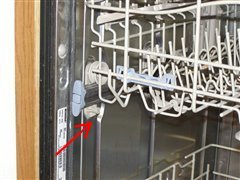
37) Repair/Replace, Evaluate - The dishwasher upper dish rack guide wheel is broken and the rack is not supported, which will result in it falling down when loaded. The guide wheel should be replaced by a qualified appliance technician.
Photo 37-1 Broken missing wheel.
38) Repair/Replace, Evaluate - The oven bake function appears to be inoperable. The client should ask the property owner about this, and if necessary, a qualified appliance technician should evaluate and repair as necessary.
39) Repair/Replace - The range hood fan vents into the kitchen rather than outdoors. Ventilation may be inadequate and moisture may accumulate indoors. Recommend having a qualified contractor make modifications as necessary as per standard building practices so the range hood fan vents outdoors.
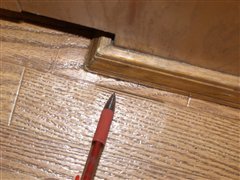
40) Repair/Replace - Vinyl flooring is damaged and/or deteriorated in one area. A qualified contractor should replace or repair the damaged flooring.
Photo 40-1
41) Comment - The refrigerator ice maker is in the "off" position. The inspector was unable to evaluate this component.
42) Comment - The following appliances were operated: Kenmore dishwasher was ran through the rinse cycle without any visible leaks. GE gas range: All stove top burners were turned on and lighted The broil function operates, but the bake function will not operate. The GE microwave/range hood appears to function correctly The G.E. refrigerator door seals were inspected.
Bathroom inspection: As a home inspector, I inspect bathroom fixtures including toilets, tubs, and sinks. Readily visible water supply and drain pipes are inspected. Plumbing access panels that I can find are opened if readily accessible and available to open. I do not perform water leak tests on drain lines or shower pans. I simply look for active leaks, which is limited by the short time in the property.
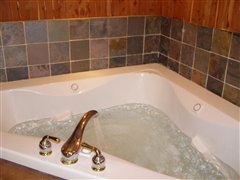
43) Cautionary, Repair/Replace, Evaluate - No ground fault circuit interrupter (GFCI) protection device is visible for the electric supply to the jetted tub. If no GFCI protection exists, then this is a safety hazard due to the risk of shock. A qualified electrician should evaluate and install GFCI protection if none is installed.
Photo 43-1
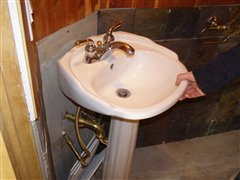
44) Repair/Replace, Evaluate - The basement bathroom sink is loose, and is not securely attached to the wall behind it. A qualified contractor should evaluate and repair as necessary.
Photo 44-1
45) Comment - The basement bathroom laundry room and small office are under construction and are not finished. Recommend if desired by the client hire a qualified contractor to finish this area.
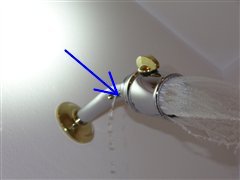
46) Repair/Replace, Evaluate - The shower head leaks at the pipe connection. A qualified plumber should evaluate and replace components or make repairs as necessary.
Photo 46-1
47) Comment - The bases of all bathroom toilets have been caulked. Caulking will prevent water from being visible if one of these fixtures starts to leak. Recommend removing caulking at the rear of the toilets base to allow any leaking water to escape and become noticed before major damages occur.
Interior inspection: As a home inspector, I check only a representative number of doors and windows. I am not required to inspect the paint, wallpaper, carpeting, window treatments and screens. I do not move furniture, lift carpets or rugs, empty closets or cabinets, and I do not comment on cosmetic deficiencies. I may not comment on cracks that appear around windows or doors, or which follow the lines of framing members and the seams of drywall and plaster board. These cracks are usually a consequence of movement, such as shrinkage and common settling, and often reappear. I do not report on odors from pets and smoking.
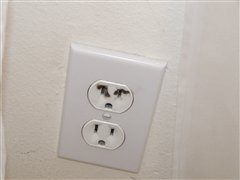
48) Cautionary, Repair/Replace, Evaluate - An electric receptacle in the master bedroom west wall has burn or scorch marks on it. Receptacle(s) and/or wiring to them may be damaged. A qualified electrician should evaluate and make repairs as necessary, such as replacing damaged receptacles and/or wiring.
Photo 48-1 scorched outlet
49) Cautionary, Repair/Replace - An insufficient number of smoke alarms are installed in the basement. Additional smoke alarms should be installed as necessary so a functioning one exists in each hallway leading to bedrooms, and in each bedroom. For more information, visit http://www.cpsc.gov/cpscpub/pubs/5077.html
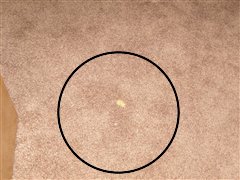
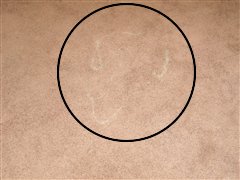
50) Repair/Replace - Carpeting in the southeast bedroom has spots in it that appear to have had the color bleached out. Recommend if desired by the client replacing carpeting where necessary.
Photo 50-1
51) Repair/Replace - Trim is missing in the basement areas. Recommend having a qualified contractor install trim where missing.
52) Maintain - Carpeting in one or more rooms is soiled and/or stained. Recommend having carpeting professionally cleaned as necessary.
Photo 52-1 Stain in living room carpet.
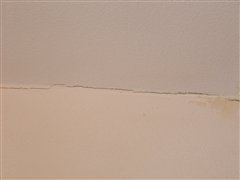
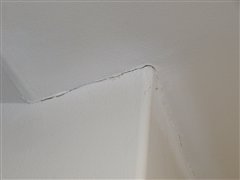
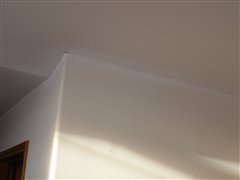
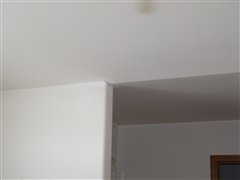
53) Comment - Cracks were found in wall and ceilings joints in one or more areas. They do not appear to be a structural concern and are likely due to poor craftsmanship, but the client may wish to repair these for aesthetic reasons.
Photo 53-1 Hall bathroom Photo 53-2 Master bedroom
Photo 53-3 Master bedroom Photo 53-4
54) Comment - Inspectors closing comments: This should be a great starter home for the client with a few concerns that are listed in this report that should be taken care of now. Most of the other concerns in this report are deferred maintenance issues and can be repaired as time and budget allows. Also recommend asking the seller for any operator owner's manuals they may have for any of the homes appliances such as the wood stove, hot water tank, furnace, whirlpool tub, and garage door opener to name a few.
55) - Most walls are in need of a fresh paint job if desired by the client.
Visible Evidence of Active Wood Destroying Insects: No
Visible Evidence of Active Wood Decay Fungi: Yes
Visible Evidence of Damage by Wood Destroying Organisms: Yes
Visible Evidence of Conditions Conducive to Wood Destroying Organisms: Yes
Disclaimer: Neither the inspector nor the inspection firm shall be liable for any corrective actions required by future inspections as a consequence of this evidence. See FINDINGS and DIAGRAM page(s) of this report bearing the same ICN, for details.
Limitation of Liability: In accordance with the provisions of the Revised Code of Washington (RCW) 15.58.450, this report relates to a single sale, transfer, exchange, or refinance and is not transferable to and may not be relied upon by parties involved in any subsequent sale, transfer, exchange, or refinance of the same property. The findings listed within this report are determined by the inspector based on a visual inspection conducted in accordance with Washington Administrative Code (WAC) 16-228-2005 through 2045 and are subject to the limitations within this report, the standards listed below, and as modified by any and all associated reports attached. The above inspecting firm and inspector endeavor to perform their services in a professional manner consistent with the care and skill ordinarily exercised by structural pest inspection professionals. The inspecting firm will re-perform any services not meeting this standard without additional compensation. In any case, the inspecting firm's total liability is hereby limited to amounts paid to the inspecting firm for the inspections made of the inspected structure. The inspecting firm will not be liable for any special, incidental, punitive or consequential damages, whether foreseen or unforeseen, regardless whether liability is based on breach of contract, breach of express or implied warranty, negligence, strict liability, tort or otherwise.
Full Home & Wood Destroying Organism Inspections WWW.GRANITEPEAKINSPECTION.COM Office 509-684-5827 Cell 509-675-4620
Home Maintenance Check List
Monthly:
1. Clean dishwasher filter(if provided), usually at lower spray arm. 2. Purge garbage disposal by first filling kitchen sink with clean water, then turn on food disposer until water is drained through. 3. Change/clean air conditioning return filters monthly. This will help keep your air cleaner and system running more efficiently. Clogged air filters will make your system operate longer than required, thereby increasing your monthly bills. 4. Wash refrigerator/freezer interior walls and door liner with solution of 1 quart warm water: 2 tablespoons of baking soda, and wipe dry. 5. Vacuum and clean all return air ducts/grills. 6. Inspect lighting fixtures and replace blown light bulbs. 7. Clean clothes drier lint traps and or ducts to reduce fire risk. 8. Clean toaster oven crumb tray.
Quarterly:
1.Inspect exterior doors to ensure they are weather tight. Adjust or replace weather stripping as needed. 2. Service doors(incl. garage doors) and drawers, clean and lubricate latches, hinges and guides. 3. Inspect and repair exterior caulking around windows, doors, and siding. 4. Replace/clean central heating system(furnace) filters. 5. Re-tighten knobs on kitchen cabinets, don't over tighten.
Semi-Annually:
1. Have heating and air conditioning systems inspected and serviced by licensed contractor. 2. Inspect and test smoke alarms and carbon monoxide detectors and replace back up batteries. 3. Check (GFCI)ground fault interrupted circuits. Test if grounded and correct polarity. 4. Inspect and maintain proper drainage around home. Clean gutters and down-pipes and ensure water is flowing away from your home. 5. Inspect home for rodent droppings or other pests. Have home treated as needed. 6. Test sump pump for reliable operation, especially before any rainy season. 7. Wash fan housing and metal filter connected to range hood exhaust fans. These can be safely washed by placing them inside the dishwasher. 8. Vacuum coils behind refrigerator/freezer to remove dust, this will improve efficiency of unit. 9. Tap off a bucket of water from the hot water heater until it runs clean.
Annually:
1. Inspect and repair settling cracks (if necessary). 2. Inspect and lubricate garage door tracks. 3. Inspect exterior paint for cracking and wear. Repaint or seal as needed. 4. Turn off power to then drain and refill water heater. 5. Trip main breaker on electric panel. 6. Inspect all electric cords and replace if necessary. 7. Inspect attic for water damage, birds, and rodents. 8. Inspect all electrical cords and replace if necessary. 9. Inspect basement for moisture/mold and wood rot. 10. Inspect attic for signs of roof leaks or water damage, bird nests, rodent or squirrel nests, and clean if necessary. 11. Change water filters and have water softeners serviced. 12. Inspect roof flashings, chimney caps, shingles(for mold and damage) and caulking for possible damage. 13. Pressure wash deck, walkways and driveway. 14. Reseal wood decks with preservative and inspect and secure nails that may be protruding out. Nails have a tendency to pop out after very cold weather conditions. 15. Clean or replace oil filter(oil fired burner only). 16. Inspect outside electrical service feeder for exposed bare wires and tree interference. 17. Inspect basement/crawl space area for signs of termites and/or other wood-boring insects. 18. Use hose to wash off dirt from coil and fan in heat pump/condenser locate outside of house. 19. Inspect all hoses(and replace if necessary) connected to laundry washer unit. 20. Clean and seal ceramic tile grout lines in bathrooms/toilets/kitchen. 21. Check caulking at tub and shower, and replace if necessary. 22. Wash and blow clean bathroom exhaust fan grill and fan blades. 23. Wash windows(exterior and interior), screens, seals and ledges. Repair if necessary. 24. Clean and lubricate sliding glass door tracks and window tracks. 25. Check stucco joints around doors and windows. 26. Inspect the dishwasher's motor motor spin seal, and replace if necessary. 27. Inspect laundry washer water fill hoses for cracks, blisters, corroded fittings and leaks. 28. Place beeswax or paraffin on built-in kitchen cabinets that have wooden guides. 29. Inspect for creosote deposits in the fireplace flue liner, these are black or brown residue of combustion that collects on the inner surfaces. If the build up is more than 1/8 inch, remove it. 30. Vacuum around the gas hot water heater(especially near furnace) to remove dirt and grime.
Tips for clogged drains:
Keeping the Drains Clear: 1. By pouring a pot of hot water down the drain once a week will melt away any fat or grease that may have built up in the drain line or P-trap. 2. If you have a clogged drain, just pour a 1/2 cup of baking soda and 1/2 cup of white vinegar down the drain. Cover the drain and let the mixture sit for a few minutes, then pour a pot of hot water down the drain. This will break down fats and also keep the drains smelling fresh. 3. Every six months, keep your drains clean by using a copper sulfide or sodium hydroxide-based drain cleaner, or other recommended drain cleaner available from your local store.
Other safety tips:
Ensure that you know where the following items are located: 1. Emergency contact telephone numbers. 2. Fire extinguishers and water hose. 3. Heating gas/fuel main shutoff valve. 4. Main electrical disconnect circuit breaker(breaker box/service panel). 5. Main drain line clean-out. 6. Main water shut off valve. 7. All window and door exits.
In addition to the above, carry out the following monthly safety checks: Some of these items may have already be included in the home maintenance list, but these monthly safety checks are advisable for safety reasons: 1. Test ground fault circuit interrupter receptacles(GFCI's). 2. Test smoke and carbon monoxide alarms, replace batteries if necessary. 3. Inspect and lubricate (if necessary) all emergency exits, including windows and doors. 4. Inspection of heating unit and water heater for visual integrity.
Home appliance estimated life spans:
1.Dishwasher water valves: 3-7 years 2.Range and oven: 18-20 years 3.Garbage disposal: 10 years 4.Microwave: 10 years 5.Refrigerator: 18-20 years 6.Laundry washer: 14 years 7.Laundry drier: 14 years 8.Refrigerator/Freezer: 18-20 years 9.Central air conditioner system: 15 years 10.Window mounted air conditioning system: 8 years 11.Bathtub/Sink: 50 years 12.Garage door opener: 10 years 13.Laundry water fill hoses: 3-5 years 14.Trash compactor: 10 years
Energy saving web-sites:
Perhaps you never thought of your home as a likely place to save you a lot of money, but it is. Most homes are far from being energy-efficient. That means if you are using more energy than you have to, you are also paying higher monthly bills than necessary. By checking out the following energy saving web-sites, you will be able to gain some wise energy saving ideas that you will be able to put to use right away. You can do many of them yourself, others may require the services of a licensed contractor: